An independent guide for the Bradford district
Bradford solar panels: what a stone roof here really makes
From the terraces of Bradford Moor and Little Horton to the hillside villages of Thornton and Haworth, most homes in the district can carry solar panels. What matters most here is the age of the house and which way its roof faces. Try yours on the estimator, then read on for prices, Saltaire, help with the cost and the checks before you sign.
Figures checked 4 November 2026 · Published independently by SEO-DONS LTD
- of households live in a terrace; England 23% (Census 2021)
- of properties were built before 1919 (VOA 2026)
- of homes reach EPC band C; England 53.3% (ONS)
- solar PV installations in the district at the end of 2025 (DESNZ)
House-age estimator · PVGIS 5.3 · ONS
Your roof, your house's age
A year from the roof
3,269 kWh
3.5 kW facing south at 35° in the city centre, with the hills' horizon (PVGIS 5.3, our arithmetic).
Homes like this
9.3%
of Bradford homes built before 1930 reach EPC band C or above; for terraced homes of any age the figure is 21.2% (ONS).
The city centre has a conservation area of that name, one of 60 in the district: check whether your street is inside it (Bradford Council).
A district of stone terraces
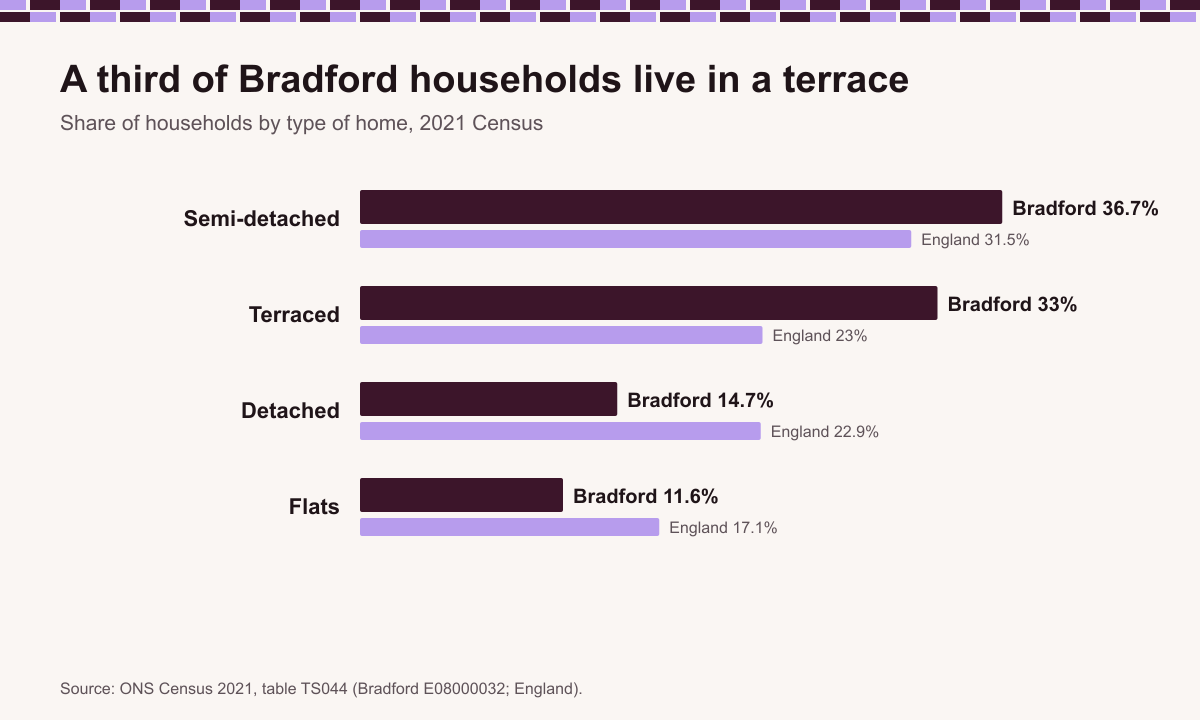
At the 2021 Census, 33% of Bradford households lived in a terraced house, well above England's 23% (ONS). In Bradford Moor the share was 59.5%, in Little Horton 55.3% and in Manningham 53.7%. Semis are commonest in Eccleshill (59.1%), and detached houses gather up the Wharfe valley in Wharfedale (36.9%) and Ilkley (27.2%).
A terrace usually owns its front and back slopes, so one of them often faces somewhere useful. What limits it is space: chimney stacks along the party walls, back extensions and dormers all take a share, and a stone or slate roof needs fixings an installer has done before. Ask each firm to show the layout on your actual slope and say what it would make there.
29.5% of the 225,120 properties on the district's council tax list were built before 1919, and 23.4% before 1900 (VOA 2026). Stone terraces, slope by slope
Why the age of the house matters more here
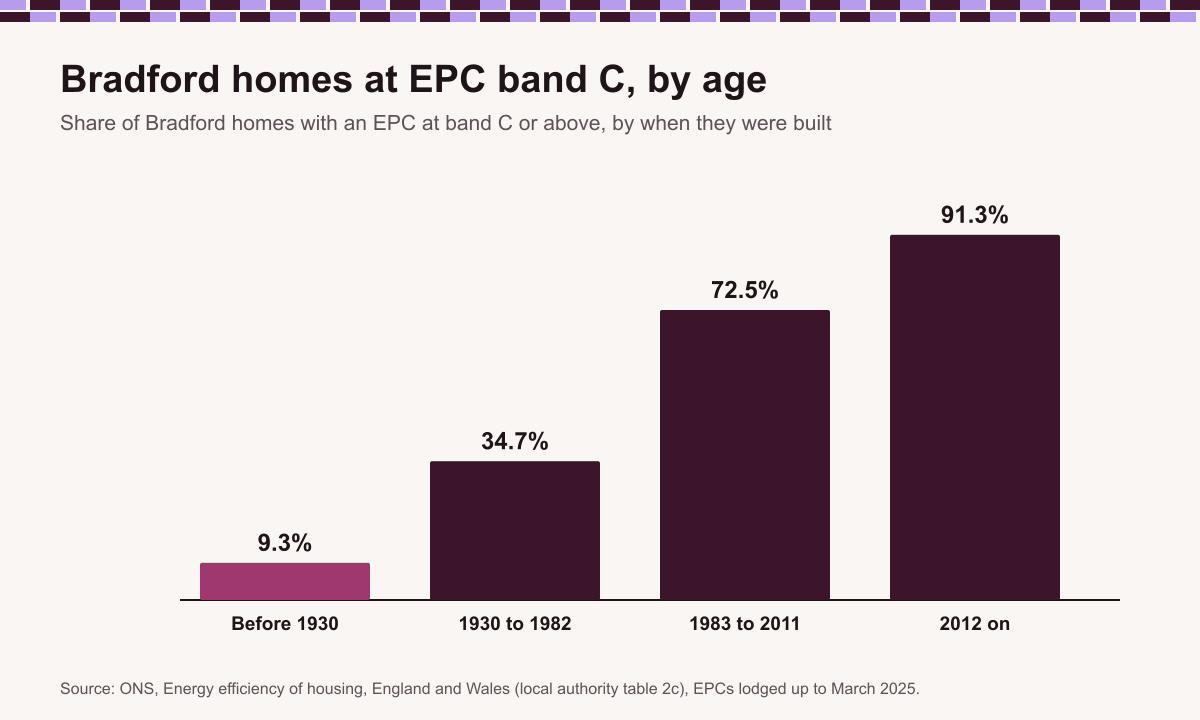
Only 37.3% of Bradford homes with an EPC reach band C or above, against 53.3% across England, and among homes built before 1930 the figure falls to 9.3% (ONS). The median energy score for those older homes is 56, against 65 for the district as a whole. Terraced homes, at 21.2%, are the least likely of any type to reach band C.
That does not rule panels out. They make the same electricity on an old roof as a new one, and they lift an EPC rating. But in a draughty stone house the first gains often come from insulation and heating, and the grants open to lower-income households follow that order. The estimator above shows the band-C share for your house's age alongside what the roof makes.
Hills, valleys and rain
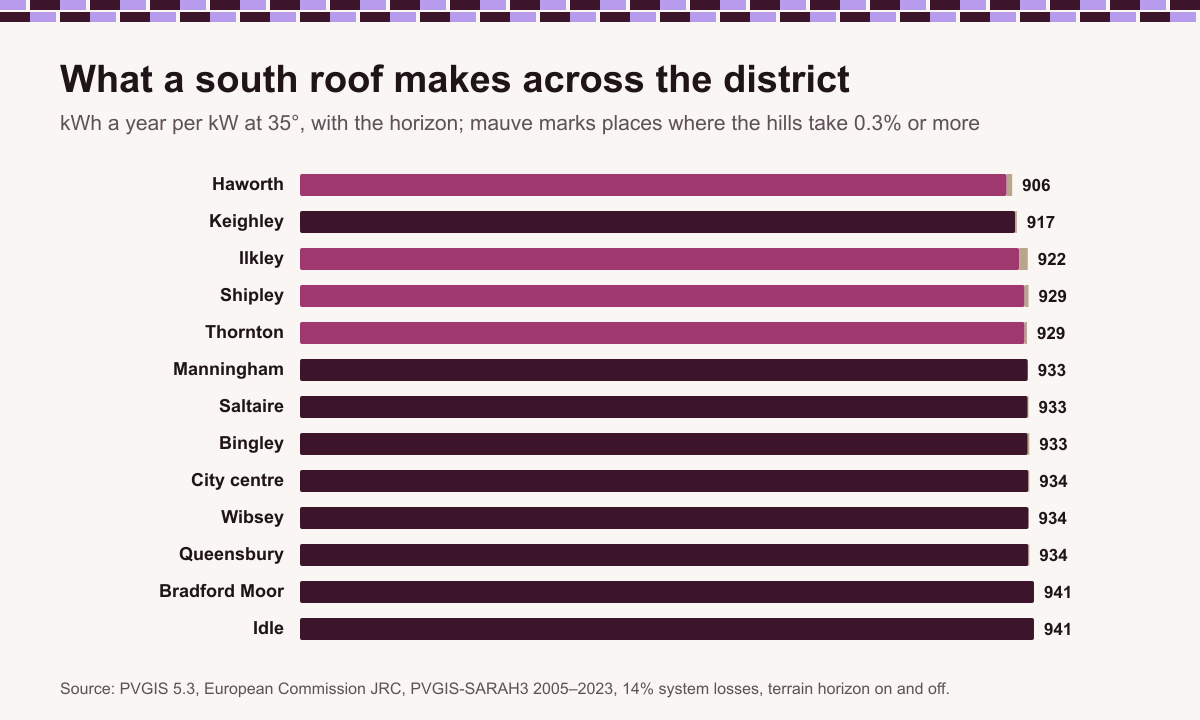
PVGIS, the European Commission's solar model, gives a south-facing roof at 35° about 934 kWh a year per kW in the city centre, and 937 at the best angle of about 41° (PVGIS 5.3). We ran it for thirteen places with the surrounding terrain switched on and off. Up on the ridges at Idle and Bradford Moor the figure is 941; down in the Worth valley at Haworth it is 906, where the hills take about 0.8%, and at Ilkley about 1.2%.
So the hills matter in a few valley towns, but less than the way a roof faces or the shade from the house next door. Rain is not the obstacle it seems either: the Met Office's 1991–2020 average at Bingley is 1,057 mm a year (Met Office), and panels generate from daylight through cloud.
Hills and valleys, place by place · Is Bradford too wet for solar?
What solar costs in Yorkshire and the Humber
The government's 2025/26 cost statistics cover 18,822 MCS-certified installations in Yorkshire and the Humber. Systems of up to 4 kW came to a mean of £1,972 per kW, and systems of 4 to 10 kW to £1,745 per kW (DESNZ). Divide any quote by its size in kW and set it against those figures.
Installed solar panels are zero-rated for VAT until 31 March 2027; from 1 April 2027 the rate is 5% (HMRC), roughly £50 more on each £1,000 of work by our arithmetic.
| Size | Mean per kW | About | kWh a year |
|---|---|---|---|
| 3 kW | £1,972 | £5,900 | 2,802 |
| 5 kW | £1,745 | £8,750 | 4,670 |
Help with the cost, and who it is for
In England there is no grant for solar panels for households that can pay for them; the government's Warm Homes Plan points those households to loans (Warm Homes Plan). For lower-income households, Bradford Council says it has delivered solar PV and battery storage across the district under the government-funded Warm Homes: Local Grant, working with Better Homes Bradford (Bradford Council). Nationally that grant is for homes at EPC D to G where the household qualifies through a low-income postcode, a means-tested benefit or an income under £36,000, with caps of £16,600 for each part (DESNZ).
The council also warns that heating offers made to households after their solar installation are not connected to it, and that the installation commits nobody to further work. All the help with the cost
Anyone with panels can be paid for spare electricity: larger suppliers must offer an export rate above zero, each setting its own terms (Ofgem).
Saltaire, conservation areas and listed homes
Roof panels on a house in England are normally permitted development, within limits rewritten from 27 August 2026 (SI 2026/896). Bradford has two layers of protection on top. Saltaire, a World Heritage Site from 2001 (UNESCO), has been covered by an Article 4 direction on external alterations made in 1976, and every property in that area was listed in 1984, so panels there need listed building consent (Bradford Council).
Across the district the council lists 60 conservation areas, from Little Germany to Haworth and Ilkley (Bradford Council), and Historic England counts 2,290 listed entries (Historic England). The other Article 4 directions, in Little Horton, Manningham and Apsley Crescent, cover dormer windows and painting stone, not solar. The planning rules in full
The local network
Northern Powergrid runs the electricity network across the district. For a small system up to 16 amps per phase (3.68 kW on a single-phase supply), the installer connects it and then notifies Northern Powergrid; bigger systems, or solar with a battery over that limit, need an application before connection (Northern Powergrid).
The quote should say which route applies and that the installer handles it. How the connection works
Twice as many installations as ten years ago
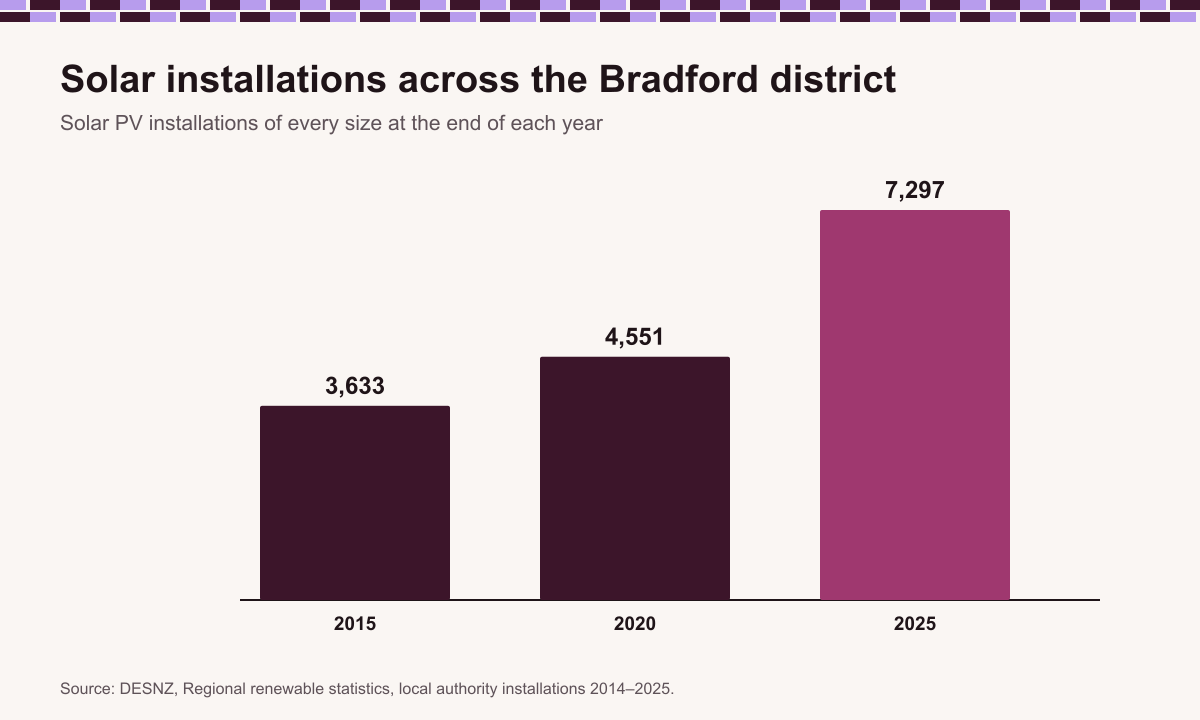
Government figures count 7,297 solar PV installations of every size in the Bradford district at the end of 2025, against 3,633 at the end of 2015 and 4,551 in 2020 (DESNZ). Most of the growth came in the last five years. Plenty of streets now have a neighbour with panels on a similar roof, which makes a useful second opinion on any estimate.
More installations also means more firms knocking on doors. The checks below are the ones the schemes themselves ask buyers to make.
Before you sign anything
This guide fits nothing and steers nobody to a firm; instead it sets out the registers and papers to check before choosing one: certification on the MCS installer search, membership of a consumer code such as RECC or HIES, a written estimate of yearly output, and a price broken down line by line. MCS suggests aiming for at least three quotes (MCS), and most contracts signed at home can be cancelled within 14 days (Consumer Contracts Regulations 2013).
- Check the roof on the estimator: the slope it uses, the hills, the house's age.
- Divide each quote by its kW and compare it with the Yorkshire and the Humber mean.
- In Saltaire or another protected area, ask who seeks the consent and when.
- Confirm who notifies Northern Powergrid, and that nothing else is signed with the solar.
Five questions Bradford readers ask first
Are solar panels worth it in Bradford?
The district gets a fair amount of light for the north of England: PVGIS gives a south-facing roof at 35° about 934 kWh a year per kW in the city centre. Whether panels suit your home depends on the roof, the shade and how much of the power you use.
Do the hills around Bradford reduce solar output?
Only a little, and only in some places. With the terrain horizon included, PVGIS gives a south roof at Haworth 906 kWh per kW against 913 without it, about 0.8% less. In the city centre the hills make almost no difference.
Can I put solar panels on a house in Saltaire?
Only with consent. Every property in Saltaire's Article 4 area became a listed building in 1984, so panels need listed building consent from Bradford Council before any work starts.
Is there help with the cost of solar in Bradford?
For eligible households, yes: Bradford Council has delivered solar PV and battery storage under the government's Warm Homes: Local Grant, working with Better Homes Bradford, for homes at EPC D to G where the household qualifies on income, benefits or postcode. Households that can pay get no solar grant, but installed solar carries 0% VAT until 31 March 2027.
Who connects solar panels in Bradford?
Northern Powergrid runs the district's network. For a small system up to 16 amps per phase (3.68 kW single-phase) the installer connects it and then notifies Northern Powergrid; larger systems need an application first.
Ask about solar on your Bradford district home
Name the town or area, roughly when the house was built and what you want to find out. SEO-DONS LTD, the company that publishes this guide, replies by email. Nobody phones or visits, and asking costs nothing.
What happens next
- Your question reaches SEO-DONS LTD, the guide's publisher.
- A reply comes back by email.
- You are not signing up to anything.